
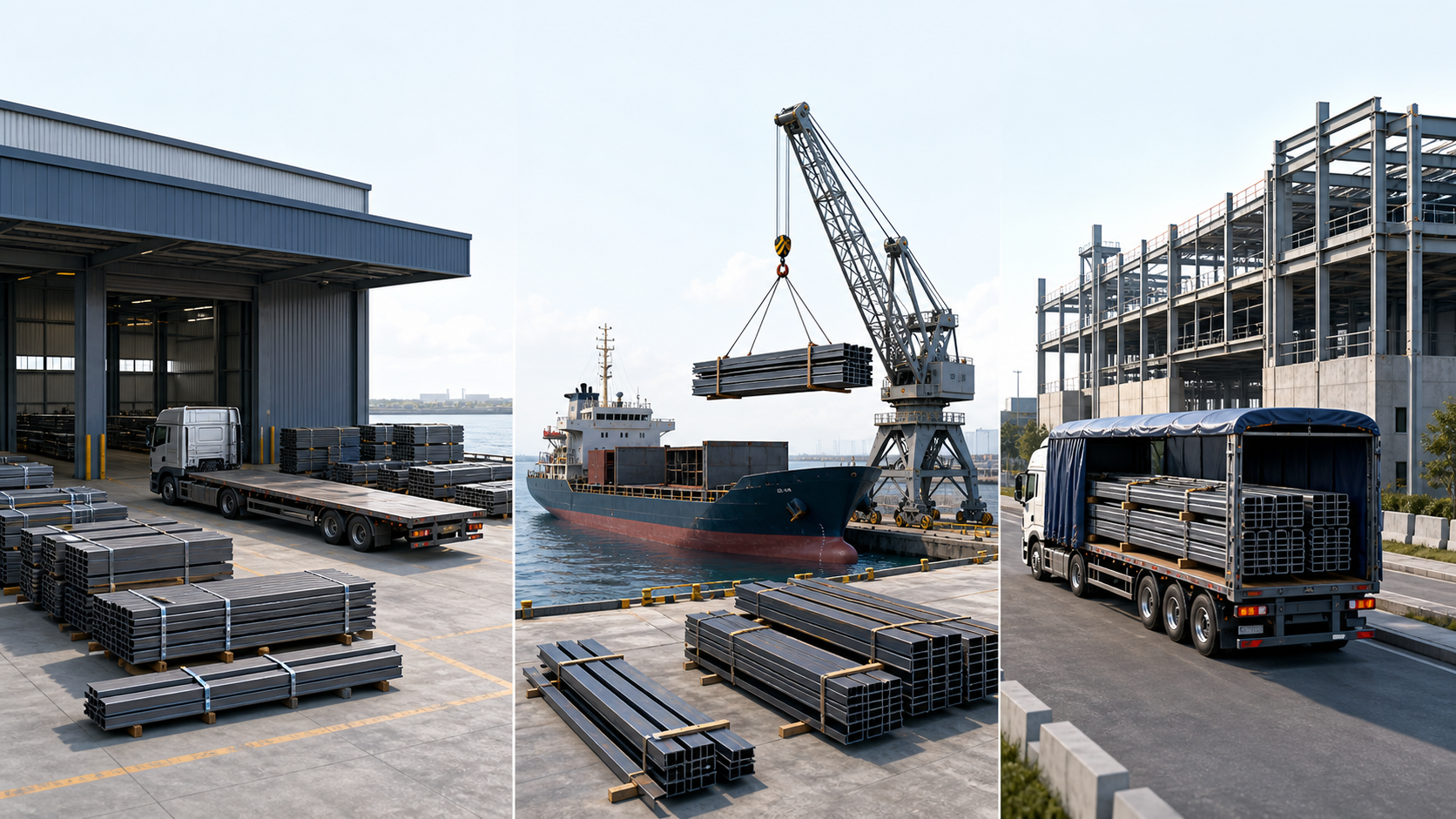
The direct answer
EXW, FOB and DAP identify different delivery and risk-transfer points. Under EXW, the seller makes the goods available at a named place, normally before loading the collecting vehicle. Under FOB, delivery occurs when the goods are on board the buyer-nominated vessel at the named port of shipment. Under DAP, the seller brings the goods to the named destination, where they are placed at the buyer’s disposal on the arriving vehicle, ready for unloading.
The correct choice depends on who can control export procedures, local pickup, port handling, ocean or multimodal carriage, destination access and import formalities. A lower EXW price can create more work and less cost visibility for the buyer. A DAP price can simplify carriage coordination, but the named destination and unloading boundary must be precise. FOB can suit appropriate conventional sea shipments, but it is not a universal term for every containerized or multimodal movement.
HF STEELS supports EXW, FOB and DAP when the selected rule and named place or port are stated in the confirmed quotation or contract. Manufacturing, documents and delivery responsibilities still follow that signed project scope. This article is practical procurement guidance, not legal, tax, customs or insurance advice.
EXW, FOB and DAP at a glance
EXW — Ex Works
Delivery point: the named factory, warehouse or other place, with the goods at the buyer’s disposal and not loaded on the collecting vehicle.
Seller side: prepare and identify the agreed goods and provide the agreed commercial information.
Buyer side: pickup, loading risk unless separately agreed, export arrangements where applicable, main carriage, import clearance, destination transport and unloading.
FOB — Free On Board
Delivery point: on board the buyer-nominated vessel at the named port of shipment.
Seller side: bring the goods to the named port, complete export clearance and place them on board as agreed.
Buyer side: nominate the vessel, arrange main sea carriage, manage import clearance and control the destination side.
DAP — Delivered at Place
Delivery point: the precise named destination, on the arriving means of transport and ready for unloading.
Seller side: arrange carriage to that destination and carry risk to the delivery point.
Buyer side: import clearance, duties and taxes, receiving access and unloading, unless a separate written clause changes a cost item.
What each term means for a fabricated steel package
EXW: maximum transport control for a prepared buyer
EXW can work when the buyer or its forwarder has reliable capability in the seller’s country. The named place should be exact, and the quotation should state whether loading assistance is separately included. Fabricated steel is not a parcel shipment: bundle length, individual member weight, lifting points, truck access, loading sequence and export formalities can materially affect collection.
The International Chamber of Commerce notes that EXW does not require the seller to load the collecting vehicle or clear the goods for export. ICC also cautions that EXW is primarily suitable for domestic trade and that FCA may be more practical where export clearance or carrier handoff is involved. A buyer should not select EXW merely because its first quoted figure is lowest.
FOB: a maritime handoff, not a synonym for “shipping included”
FOB is limited to sea and inland-waterway transport. Delivery and risk transfer occur after the goods are on board the vessel nominated by the buyer at the named port. The buyer therefore needs a workable vessel nomination, booking and communication process; the seller needs enough information to complete export and port-side obligations.
For fabricated steel, the quote should identify the named Chinese port, whether the shipment is conventional cargo or containerized, who controls container or vessel cut-off dates, and which port charges are included. ICC guidance indicates that FCA should be considered for containerized or multimodal cargo where the seller hands the goods to a carrier before they are actually on board a vessel. The physical route should drive the rule—not habit.
DAP: seller-arranged carriage to a precise destination
DAP can give the buyer a clearer carriage boundary because the seller arranges transport to the named place. Delivery occurs while the goods remain on the arriving vehicle, ready for unloading. The buyer normally handles import clearance and bears unloading risk. The phrase “DAP project site” is not precise enough for a complex industrial location: gate, laydown area, access restrictions, road limits, delivery hours and vehicle acceptance should be defined.
DAP does not automatically make the seller the importer of record, pay import duties or unload steel members. It also does not replace the need to define who supplies cranes, lifting plans, labor, temporary storage and damage-receipt records. Those destination activities require a separate responsibility schedule.
Use a responsibility matrix before comparing prices
Normalize each quotation against the same logistics boundary. The following ten rows expose most hidden differences:
- Named delivery point: full factory address, named port and terminal, or exact destination point.
- Production release: approved drawing revision, member list, coating scope and release status.
- Packing basis: bundle method, marks, protection, packing-list fields and lifting constraints.
- Factory loading: who supplies labor and lifting equipment, and who bears loading risk.
- Export clearance: responsible party, required buyer data and document handoff.
- Origin charges: inland haulage, terminal handling, special equipment and waiting time.
- Main carriage: who books, pays, receives schedule notices and manages carrier exceptions.
- Insurance decision: who arranges the chosen cargo cover; the selected rule does not by itself make the commercial quote an insurance policy.
- Import and destination charges: customs clearance, duties, taxes, terminal charges and local permits.
- Unloading and receiving: crane, labor, safe access, package reconciliation, visible-damage record and storage.
Use the steel building delivery-boundary checklist to expand this matrix into a full scope schedule. The trade term is one row in that schedule; it is not the entire delivery agreement.
A practical selection path
You control origin pickup
Your forwarder can collect at the named place, manage loading arrangements, handle export issues and coordinate the full route with the factory.
The handoff is genuinely on board
The cargo and route suit a maritime rule, the buyer can nominate the vessel, and both parties can manage the named port and on-board delivery point.
You need carriage to destination
The seller can price the route to a precise named place, while the buyer can manage import formalities, destination access and unloading.
If none of those descriptions matches the actual carrier handoff, ask whether another Incoterms® 2020 rule is more accurate. In particular, do not force FOB onto a containerized or multimodal route solely because “FOB price” is familiar to the procurement team.
How to write the trade term in an RFQ
A useful RFQ does not say only “quote FOB” or “quote DAP.” It gives the rule, the named place or port, the applicable Incoterms® edition and the assumptions required to price the steel package.
- Write the precise place: for example, a named factory collection point, a named Chinese port, or an exact destination address and handoff point.
- State “Incoterms® 2020” so the edition is unambiguous.
- Provide member dimensions, estimated package profile and any known transport constraints.
- Define whether loading, special lifting, container stuffing, lashing or dunnage is included.
- List required packing, loading and shipping documents.
- For DAP, describe destination access, receiving hours, road limits and unloading responsibility.
- Ask for exclusions, third-party costs, validity period and change assumptions in writing.
- Keep fabrication scope, payment, title, inspection, delay remedies and dispute terms in separate contract clauses.
For a fabrication-ready package, combine the logistics request with the fabrication-from-drawings scope, the quality and document requirements, and the project workflow.
What Incoterms® rules do not decide
Incoterms® rules allocate defined delivery, risk, cost and formalities responsibilities, but they do not turn an incomplete steel inquiry into a complete contract. They do not specify the structural design basis, connection responsibility, drawing approval, material grade, tolerances, welding acceptance, coating system, inspection plan, document package, payment terms, ownership transfer, force majeure, remedies or governing law.
They also do not make conditional HF STEELS services automatic. HF STEELS does not provide on-site installation, erection labor or site supervision. Installation drawings and remote technical guidance are available only when included in the confirmed agreement. No fixed tonnage threshold applies to inquiry review. These boundaries should appear in the quotation wherever they affect the buyer’s comparison.
Source basis and review note
This guide was reviewed against the International Chamber of Commerce’s official Incoterms® 2020 overview, its official explanations for EXW and DAP, and ICC guidance on delivery and risk transfer, including FOB. Buyers should use the licensed ICC rules and obtain transaction-specific professional advice where legal, customs, tax or insurance consequences matter.
EXW, FOB and DAP FAQ for Steel Buyers
What is the main difference between EXW, FOB and DAP for fabricated steel?
The delivery point: EXW at the named factory or place before loading; FOB on board the buyer-nominated vessel at the named port; DAP at the named destination on the arriving vehicle ready for unloading.
Who unloads under DAP?
The buyer takes delivery with the goods ready for unloading and bears unloading risk. The quotation and carriage contract should also state how any unloading cost is handled.
Is FOB suitable for every fabricated steel shipment?
No. FOB is a maritime rule. Containerized or multimodal shipments may have an earlier carrier handoff, so FCA or another rule may fit the physical route better.
Does an Incoterms rule define the complete fabrication scope?
No. Drawings, materials, fabrication, coating, inspection, documents, payment and project remedies need separate quotation and contract clauses.
Which trade terms can HF STEELS quote?
HF STEELS supports EXW, FOB and DAP when the chosen rule, named place or port and project-specific responsibilities are stated in the confirmed quotation or contract.
Request a Comparable Steel Quotation
Send the drawings, fabrication scope, package constraints, destination and preferred trade term. HF STEELS can then state the named handoff point, included responsibilities and exclusions in the quotation.
Submit Drawings and Delivery Requirements